Fiber Optic Internet: The Gold Standard of Home Networking
Over 800 words exploring the incredible physics behind fiber optic technology, its massive benefits over copper cables, and why it is the definitive future of high-speed electronics.
Telecommunications Engineer
Contributor & Technical Writer
The Physics of Light vs. The Physics of Electricity
In this article, we analyze the core concepts of fiber optic internet to help you build a reliable, high-performance home system. As a result, for over a century, global telecommunications have relied on the transmission of electricity through copper wires. However, from early telegraphs to modern DSL and Coaxial cable internet, the methodology remained the same: encoding data as electrical pulses. However, copper has severe physical limitations. In addition, electrical signals degrade rapidly over long distances (attenuation), generate massive amounts of heat, and are highly susceptible to Electromagnetic Interference (EMI) from nearby power lines, radio waves, and even solar flares.
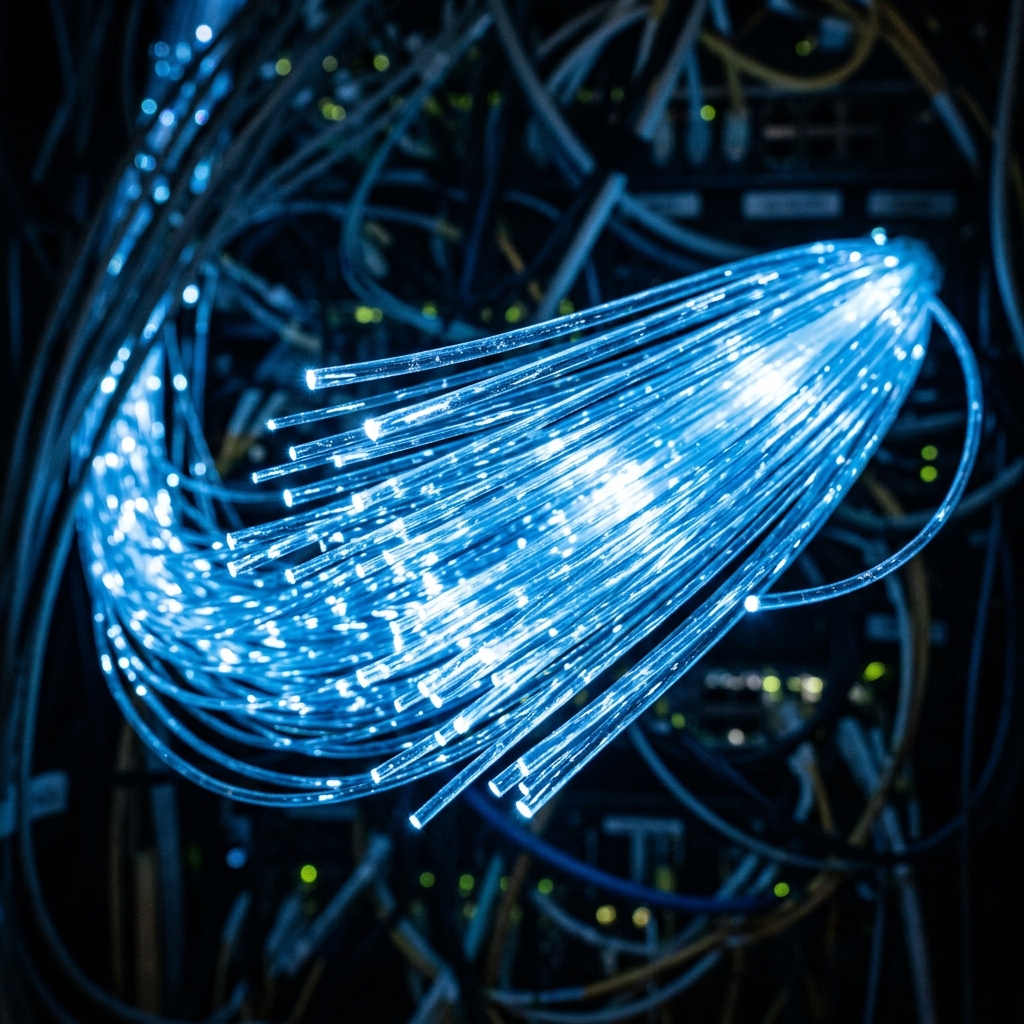
Fiber Optic technology completely abandons electricity. Instead of pushing electrons through heavy metal wire, it pulses laser light through microscopic strands of ultra-pure glass, no thicker than a human hair. Specifically, by utilizing the physical properties of light and total internal reflection, fiber optics represents a quantum leap in data transmission, offering virtually unlimited bandwidth and completely revolutionizing how our electronics connect to the world. Consequently, managing fiber optic internet is critical for achieving optimal speeds.
Symmetrical Speeds: The Fiber Advantage
The most glaring flaw of traditional Cable (Coaxial) internet is its asymmetrical nature. Because cable networks were originally designed in the 1980s solely to download television broadcasts from a central hub to a home, the infrastructure dedicates 95% of its capacity to the "Download" stream, leaving a microscopic lane for the "Upload" stream.
In the modern era of cloud backups, remote work video conferencing, and live streaming, a fast upload speed is critical. Consequently, a standard gigabit cable connection might offer 1000 Mbps download but a pathetic 35 Mbps upload. Therefore, fiber Optic networks are inherently symmetrical. Additionally, if you purchase a gigabit fiber plan, you receive 1000 Mbps download AND 1000 Mbps upload. Furthermore, this allows your electronic devices to sync massive files to cloud servers instantaneously, completely eliminating the upload bottlenecks that cripple cable users.
Immunity to Interference and Degradation
Because fiber optic cables transmit photons of light rather than electrical currents, they are completely immune to Electromagnetic Interference. Meanwhile, you can run a fiber cable directly alongside a massive high-voltage power generator, and the data stream will not experience a single error or dropped packet. Subsequently, this physical immunity makes fiber incredibly stable and reliable; the connection does not drop during thunderstorms, nor does it degrade when exposed to water or extreme temperatures.
Furthermore, light experiences very little signal loss over distance. However, a copper cable requires an electronic "repeater" to boost the signal every few hundred feet. In addition, a single strand of fiber optic glass can carry a multi-gigabit signal for dozens of miles without requiring a single piece of electronic boosting equipment, resulting in a drastically lower latency (ping) connection.

Future-Proofing Your Home Infrastructure
The most remarkable aspect of fiber optic technology is that the physical glass cable in the ground has a virtually infinite bandwidth capacity. Specifically, when an ISP wants to increase the speed of a fiber network from 1 Gigabit to 10 Gigabits, or even 100 Gigabits, they do not need to dig up the streets to replace the glass cable. As a result, they simply upgrade the electronic laser equipment at the endpoints.
This means that if your home is connected via Fiber to the Premises (FTTP), your physical infrastructure is completely future-proofed for decades. Furthermore, as 8K video, advanced Virtual Reality, and increasingly complex IoT electronics demand exponentially more data, your fiber connection will seamlessly scale to meet those demands with a simple hardware swap at the modem.

To learn more about related technologies, check out our guide on high-speed internet. Additionally, for additional industry resources and guidelines, visit the official FCC Broadband Map. Consequently, managing fiber optic internet is critical for achieving optimal speeds.
Conclusion
If fiber optic internet is available in your geographical area, migrating to it is the single most important technological upgrade you can make for your home. Consequently, it provides symmetrical gigabit speeds, zero latency, immunity to interference, and infinite future scalability. Therefore, fiber optics is not just an alternative to cable; it is the ultimate, undisputed gold standard foundation upon which all modern and future high-speed electronics rely.
Share this guide